



Dental Services
Get Started Today!
Ohio Location
(614)999-1500
Monday To Friday
08:00am - 05:00pm Closed on Weekends
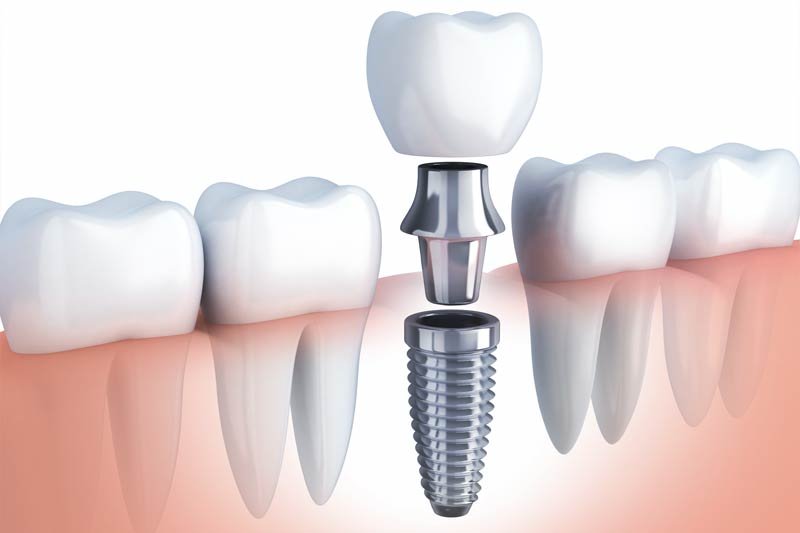
Advantages of single dental implant over other treatment options:
- Natural appearance
- Solid, natural chewing
- Attached securely and permanently
- Significantly reduces bone loss after removal of a tooth
- No negative impact to nearby teeth like with other options (bridges)
What Is a Dental Implant?
A dental implant is a titanium screw that serves as the root to your new tooth.
There are 3 parts to an implant tooth:
- Implant Body – this is the foundation. It is placed in the jaw and acts as an anchor for the replacement tooth.
- Abutment – this connects the implant to the crown.
- Crown – this is the part that you can see in the mouth. It mimics natural tooth appearance and function.
How Does The Process Work
- Placement of implant post in jaw
- Digitally scan for abutment and crown
- Attach crown and abutment to implant body
After being thoroughly numbed, the implant body (the titanium screw) is surgically placed in your jaw.
The implant body is made of surgical-grade titanium (the same material used in hip and knee replacements), which means your bone will fuse with it over a 4-6 month period (a process known as osseointegration). Once the dental implant is properly integrated, we will take impressions to have your abutment and crown fabricated.
The crown is the part of the implant tooth that you actually see in the mouth and the abutment is the support piece that connects the crown to the implant body.
How Long Does The Process Take?
The process typically takes 5-6 months from start to finish.
- Place implant body and wait 4 months for integration into jaw bone.
- Uncover implants and allow gums to form to correct shape for 2 weeks.
- Take impressions and send off to outside lab for fabrication of abutment and crown. This normally takes 3-4 weeks.
- Place abutment and crown.
For some patients, the process could take longer than described here.
What are dental implants?
A dental implant is a small post that is placed directly into your jawbone to replace the root of a missing tooth. Once the implant integrates with your bone, a custom-made crown is attached to it, giving you a replacement tooth that looks, feels, and functions like the real thing. Implants can replace a single missing tooth, several teeth with an implant-supported bridge, or a full arch of teeth.
Am I a candidate for dental implants?
Most people are candidates for dental implants, even those who have been told they weren’t in the past. Advances in bone grafting, sinus lifts, and implant placement techniques have made it possible for far more patients to qualify than even a few years ago.
Conditions like bone loss, periodontal disease, diabetes, or smoking don’t automatically rule you out. Your doctor will evaluate your jawbone, review your health history, and determine the best path forward during your consultation. If you’ve been told no before, it’s worth getting a second opinion.
Do I need an implant for each of my missing teeth?
Not necessarily. If you’re missing a single tooth, one implant with a crown is the standard approach. But if you’re missing multiple teeth in a row, an implant-supported bridge can replace several teeth using just two or three implants as anchors. Every case is different, so we’ll need to evaluate your specific situation during a consultation to determine the most effective and affordable treatment plan for you.
What is the process for getting an implant?
The process is straightforward. Your implant is placed into your jawbone and then left to integrate with the bone over a period of 3 to 6 months. This integration phase is what gives the implant its long-term stability. Once your doctor confirms that the implant has fully fused, we take impressions and have your custom crown or bridge fabricated.
If bone grafting or a sinus lift is needed before placement, that will add some time to the overall timeline. Your doctor will walk you through exactly what your treatment plan looks like and how long you can expect the process to take during your consultation.
How much do dental implants cost?
The cost of dental implants depends on your specific case, including how many implants you need, whether bone grafting is required, and the type of restoration being placed. At ViaSmiles, we provide a detailed estimate during your consultation that covers every phase of treatment so you know exactly what your investment looks like from the start.
We offer flexible financing and payment plan options, including CareCredit, to make treatment fit your budget. Many patients are surprised at how affordable implants can be when broken down into monthly payments, especially when compared to the ongoing cost of replacing bridges or dealing with the consequences of leaving gaps untreated.
Will my insurance cover any of my treatment?
More insurance plans are covering dental implant services today than ever before. Coverage varies by plan, but many will pay toward a portion of your treatment, whether that’s the implant placement, the crown, or both. Some plans apply implant coverage under major restorative benefits, while others have separate allowances.
The best way to find out what your plan covers is to bring your insurance information to your consultation. Our team will verify your benefits and help you understand what your out-of-pocket cost will be.
Does Medicare cover dental implants?
Traditional Medicare does not cover dental implants or most other dental services. However, some Medicare Advantage plans do provide coverage for dental implant procedures.
What do implant teeth look like?
In your mouth, an implant tooth looks virtually identical to a natural tooth. The implant itself, the post that anchors into your jawbone, is completely hidden beneath your gums. All anyone sees is the crown, which is custom-made to match the shade, shape, and size of your surrounding teeth. Most people won’t be able to tell the difference between your implant and your natural teeth.
Will it function and feel like a natural tooth?
Yes. Once your implant is fully integrated and your crown is placed, it functions just like a natural tooth. You can eat, chew, and bite with full confidence. It will feel slightly different from a natural tooth since there’s no periodontal ligament around an implant the way there is around a natural root, but in terms of everyday function, you won’t notice a difference.
Is my implant removable?
No. Once your implant and crown are fully placed, they are a permanent, fixed part of your mouth. You care for them the same way you care for your natural teeth. They don’t come out, and there’s nothing to remove, soak, or reattach.
Can you put a temporary crown or bridge on my implant the same day it's placed?
At this time, we do not place temporary crowns or bridges on implants the same day they are placed. The reason is that we want as little force as possible on your implants while they integrate with your jawbone. Putting a temporary crown or bridge on too early can interfere with that process and compromise the long-term success of the implant. Allowing the implant to heal undisturbed for 3 to 6 months gives you the strongest, most predictable outcome.
Will there be pain after the procedure?
Most patients are pleasantly surprised by how little discomfort they experience after implant placement. Some soreness and swelling is normal in the first day or two, but many patients report it’s far less than they expected. You’ll be prescribed medication to manage any discomfort during the initial recovery period.
Can I be put to sleep for my procedure?
We offer multiple sedation options for patients who are nervous about their procedure. Whether you’re dealing with dental anxiety, a strong gag reflex, or just prefer not to be aware during surgery, sedation can make the entire experience more comfortable.
During your consultation, your doctor will review your health history to determine which sedation option is the best fit for you. Many patients who were nervous or even terrified about the procedure say that knowing sedation was available is what gave them the confidence to finally move forward.
How long should I take off work for recovery after my procedure?
Most patients are able to return to work the same day or the next day after a single implant placement. More involved cases, such as multiple implants, bone grafting, or extractions combined with implant placement, may require a few extra days. Your doctor will give you a realistic expectation based on your specific treatment plan.
How long will I bleed after the procedure?
You may have some slight bleeding for the first 24 hours after your implant is placed. This is normal and typically resolves on its own. If you feel like you’re bleeding more than expected, call the clinic.
A simple and effective home remedy for managing bleeding is tea bags. Dampen a regular tea bag, wring out the excess water, and place it directly on the extraction or surgical site. The tannins in the tea promote clotting. You can use multiple tea bags at once and replace them as they become saturated. Repeat as needed until the bleeding subsides.
What kind of aftercare will I need with my dental implants?
One of the best things about dental implants is that you care for them just like natural teeth. Brush twice a day, floss daily, and keep up with professional cleanings at the intervals your doctor recommends. A water flosser is a great addition to your routine for cleaning around the implant and beneath an implant-supported bridge where debris can collect.
Because implants can still be affected by gum disease and bone loss around the implant site, staying consistent with your oral hygiene and maintenance visits is the best way to protect your investment for the long term.
Can implants fail?
Dental implants have a success rate above 95%, making them one of the most reliable procedures in modern dentistry. That said, failure can still happen in a small number of cases. The most common reasons include failure of the implant to integrate with the bone, complications related to smoking, uncontrolled diabetes, infection at the implant site, or excessive force on the implant during the healing period.
This is one of the reasons we don’t place temporary crowns on the same day as your implant. Protecting the implant during the integration phase gives it the best chance of long-term success.
Do you offer zirconia (non-metal) implants?
We do not offer zirconia implants at this time. While we do use zirconia for crowns and bridges, zirconia as an implant body material is still relatively new to the market and does not have the same long-term track record as titanium.
Titanium implants have been used successfully for decades, and the data supporting their longevity and predictability is extensive. Zirconia implants carry a higher risk of fracture because the material, while extremely hard, is also more brittle than titanium. A titanium implant can flex slightly under load without failing. A zirconia implant under the same stress is more likely to crack, and unlike titanium, a fractured zirconia implant cannot be repaired. It has to be surgically removed and replaced entirely.
We want the most successful, most predictable, best long-term results for our patients. Until zirconia implants have the clinical history to match titanium, we’ll continue using what we know works.
What happens if I don't replace a missing tooth?
Leaving a gap in your mouth does more than affect your appearance. Over time, the teeth surrounding the empty space will begin to shift and tilt into the gap, which can throw off your bite and create new problems. The bone in the area where the tooth was lost also begins to deteriorate because it’s no longer being stimulated by a root. This bone loss can change the shape of your face and make future implant placement more complicated if you wait too long.
Replacing a missing tooth with an implant preserves your bone, keeps your surrounding teeth in their proper position, and prevents a small problem from becoming a bigger and more expensive one down the road.
Free Consultation for Dental Implants Including 3D CT Scan
Our practice offers a complimentary initial consultation, examination, and 3D CT scan valued at $450!
Find out if you’re a candidate for dental implants.