



Dental Services
Get Started Today!
Ohio Location
(614)999-1500
Monday To Friday
08:00am - 05:00pm Closed on Weekends
Snap-In Implant Dentures (Removable)
BENEFITS OF SNAP-IN DENTAL IMPLANT DENTURES:
- Significantly improved chewing
- Easier to speak thanks to stable dentures
- More natural appearance Reduce or eliminate gagging
- Taste food better
- Increased stability = reduction of sore spots
- Bone retention
- Easy cleaning and maintenance
- More affordable than you might think
WHAT ARE SNAP-IN IMPLANT DENTURES?
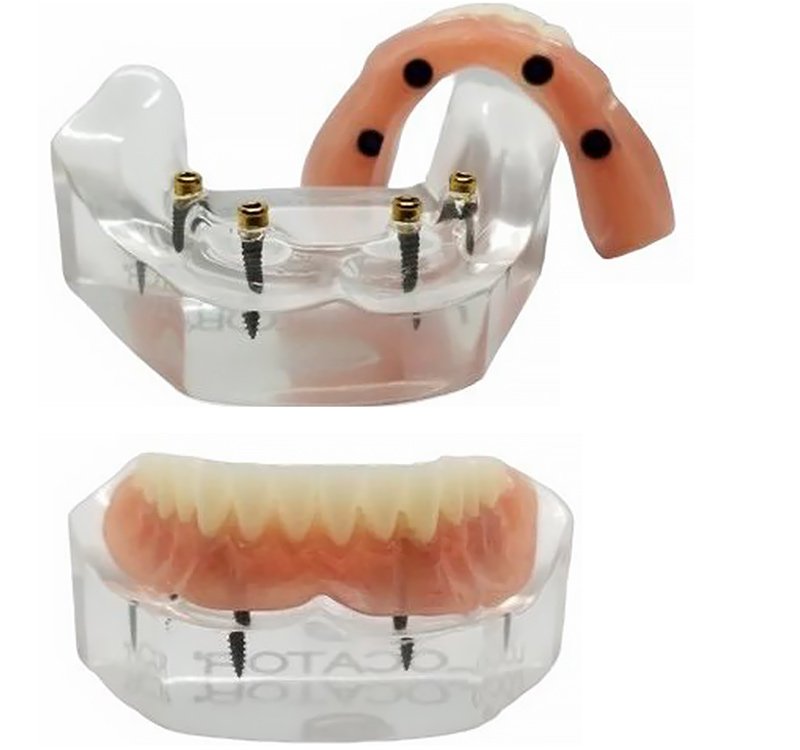
These are dentures with special fittings that allow them to attach (snap-in) to the dental implants your doctor places.
The denture removed from the simulated lower jaw shows the attachments in the denture as well as the implants and abutments in the lower jaw.
The lower denture securely snapped on to the implants.
Why should I choose implant dentures over traditional dentures?
While traditional dentures typically look nice and are the most cost-effective way to replace bad or missing teeth, they can leave a lot to be desired in terms of overall function, stability, and chewing ability.
Shortfalls of traditional (non-implant) dentures:
Limited chewing power - very little chewing power due to movement of the lower denture; usually only 10-20% of what a person had with natural teeth. The movements of a denture wearer’s tongue and cheeks continually push and pull on the lower denture, keeping it unstable.
Speech - speaking can be difficult due to the movement of the lower denture.
Embarrassment - caused by the inability to eat around other people, laugh loudly, and converse confidently due to fear of dentures becoming loose and falling out.
Discomfort - since traditional dentures, especially lowers, often move around, they can rub and chafe the gums, causing irritation and discomfort.
Poor nutrition - again, due to the loss of chewing power, patients may be unable to eat a balanced diet and chew food sufficiently for proper digestion.
Bone loss - after a person’s teeth are removed, they typically lose a great deal of bone and will continue to lose it for the remainder of their life. This means that traditional dentures become more and more difficult to wear over time.
Gagging - traditional upper dentures cover the roof of the mouth to provide suction and stability. Unfortunately, for many people, the denture covering the roof of their mouth causes them to gag. Trimming the denture to reduce this gagging leads to a decrease in stability and loss of natural suction.
Anchoring your dentures with dental implants allows you to:
Enjoy more of your favorite foods - By securing your denture with dental implants, patients are able to chew with much greater power and confidence.
Speak confidently - speak in front of crowds or amongst friends and family with the confidence of knowing your denture is securely snapped onto your implants.
Smile and laugh without worry of your dentures falling out.
Live more comfortably - dentures not moving as much, less rubbing and chafing.
Receive better nutrition - chew up food better.
Reduce bone loss - while a person may continue to lose bone after having their natural teeth removed, dental implants provide stimulation down into the jaw which encourages the body to continue to produce bone.
Reduce or eliminate gagging - since your upper implant denture will be secured in place by the implants, a significant portion of the palate can be removed, exposing the roof of the mouth. This reduces or eliminates gagging caused by your denture.
Increased comfort - dental implants help reduce or eliminate the irritation caused by movement of the dentures.
Taste your food better - most patients with implants can have part of their upper denture’s palate removed. This allows you to taste your food better.
Q1. What are Snap-In Implant Dentures?
Snap-In Implant Dentures are removable dentures designed with special attachments that “snap” securely onto dental implants placed in your jaw. This provides much more stability, chewing power, and comfort compared to traditional dentures. While the dentures can be removed for easy cleaning, they stay firmly in place during speaking, eating, and smiling.
Q2. How are Snap-In Implant Dentures different from traditional dentures?
Traditional dentures rest on the gums and can move, slip, or cause sore spots. Snap-In Implant Dentures anchor to dental implants, giving you:
-
Stronger chewing ability
-
Better stability with less movement
-
More confident speaking and laughing
-
Reduced gum irritation
-
Less gagging (especially on the upper denture)
-
A more natural feel overall
They also help preserve jawbone, while traditional dentures can accelerate bone loss over time.
Q3. What are the biggest benefits of Snap-In Implant Dentures?
Patients typically experience:
-
Secure, stable teeth that don’t slip or fall out
-
Improved chewing power
-
Easier, clearer speech
-
More natural appearance and comfort
-
Less gagging due to reduced palate coverage
-
Better tasting of food
-
Fewer sore spots
-
Easier cleaning and maintenance
-
Long-term bone preservation
-
A more confident smile and improved quality of life
Q4. Am I a good candidate for Snap-In Implant Dentures?
Most patients who are tired of loose, uncomfortable dentures or who struggle with chewing, speaking, or confidence are excellent candidates. As long as you have enough jawbone to support dental implants—or are willing to undergo bone grafting—you may qualify. A consultation will determine your best treatment option.
Q5. Do Snap-In Dentures improve chewing and eating?
Yes—significantly. While traditional dentures provide only about 10–20% of normal chewing power, implant-supported dentures greatly improve your ability to eat a wider variety of foods comfortably and confidently.
Q6. Will Snap-In Dentures help with gagging?
In many cases, yes. Because the implants hold the upper denture in place, a large portion of the palate (roof of the mouth) can be removed. This greatly reduces or eliminates gagging and also improves your ability to taste food.
Q7. Can Snap-In Implant Dentures prevent bone loss?
Yes. Dental implants stimulate the jawbone just like natural tooth roots, helping preserve bone and slow down the bone loss that typically occurs with traditional dentures.
What are snap-in implant dentures?
Snap-in implant dentures are removable dentures that attach to dental implants for a significantly more stable and secure fit than traditional dentures alone. The implants are placed into your jawbone, and your denture snaps onto them using special attachments called inserts. You get the stability of implants with the convenience of a denture you can still remove for easy cleaning.
Am I a candidate for snap-in implant dentures?
Most patients are candidates, even those who have been wearing traditional dentures for years. The main factor is whether you have enough bone in your jaw to support implants. During your consultation, we’ll take a 3D CBCT scan of your jaw to evaluate your bone and determine the best treatment plan for your situation.
Conditions like bone loss, periodontal disease, diabetes, or smoking don’t automatically disqualify you. In some cases, bone grafting can make implant placement possible even when bone has been lost over time from years of wearing dentures.
How many implants will I need?
An upper implant denture requires at least 4 implants. A lower implant denture requires at least 2. Generally, the more implants you have, the more stable and secure your denture will be.
This is especially true with the lower jaw. Two implants in the lower will make a noticeable improvement over a traditional denture, but three or four implants usually provide a much better experience in terms of stability, comfort, and chewing ability.
Your doctor will recommend the number of implants that makes the most sense for your anatomy and your goals during your consultation.
How much do snap-in implant dentures cost?
The cost depends on your individual case, including how many implants you need, whether bone grafting or other preparatory procedures are required, and whether you need new dentures fabricated or can retrofit your existing ones. At ViaSmiles, we provide a complete estimate during your consultation that covers every phase of treatment so there are no surprises.
We offer flexible financing and payment plan options, including CareCredit, to make treatment accessible. If you’re wondering whether your insurance or Medicare covers any portion of the cost, our team can help you figure that out.
Will my insurance cover any of my treatment?
More insurance plans are covering dental implant services today than ever before. Coverage varies by plan, but many will pay toward a portion of your treatment, whether that’s the implant placement, the restoration, or both. Some plans apply implant coverage under major restorative benefits, while others have separate allowances.
The best way to find out what your plan covers is to bring your insurance information to your consultation. Our team will verify your benefits and help you understand what your out-of-pocket cost will be.
Does Medicare cover dental implants?
Traditional Medicare does not cover dental implants or most other dental services. However, some Medicare Advantage plans do provide coverage for dental implant procedures.
What is the process for getting snap-in implant dentures?
The process starts with your consultation, where we’ll scan your jaw and develop your treatment plan. On your procedure day, your implants are placed into your jawbone. If you’re having teeth extracted at the same time, immediate dentures can be placed so you don’t go without teeth while you heal.
From there, we wait 4 to 6 months for your implants to fully integrate with your bone. During this healing phase, you’ll wear your dentures as normal, and we’ll place soft liners as needed to keep the fit comfortable as your mouth changes shape.
Once your implants have fully integrated, we attach the snap components and deliver your final denture. If you’re a candidate for a palate-less upper denture, this is when that modification is made as well.
Will I get to use my implants the same day they're placed?
No. Your implants need time to integrate with your jawbone, and this process is what gives them their long-term stability. Attaching to your implants too early can compromise that integration and affect how well they perform for years to come. We typically wait 4 to 6 months before snapping your denture onto your implants. In the meantime, you’ll wear your dentures with soft liners to keep you comfortable throughout the healing phase.
Are implant dentures really secure?
Yes. Snap-in implant dentures are significantly more secure than traditional dentures alone. The implants anchor your denture in place, which means far less slipping, rocking, and movement when you eat and speak. If you prefer an even tighter hold, we can increase the retention with stronger inserts. Most patients who make the switch from traditional dentures to implant-supported dentures say the difference in stability is dramatic.
Are implant dentures removable?
Yes. One of the advantages of snap-in implant dentures is that they’re easy to remove for cleaning. Simply unsnap them, clean the denture, brush your gums and implants, and snap them back in. This convenience makes daily home care simple and keeps your implants and tissue healthy.
I can't stand having the roof of my mouth covered. What are my options?
If having the roof of your mouth (your palate) covered is something you can’t tolerate, there are two paths that can help. Snap-in implant dentures with enough implants in the upper jaw allow us to remove most of the palate while keeping the denture stable and functional. For patients who want to eliminate the palate entirely and move to a fully fixed solution, All-On-4® is the other option. Your doctor can help you determine which approach is the right fit during your consultation.
I can't taste as much with my dentures. Is this normal?
Yes. A full upper denture covers the roof of your mouth, which is where many of your taste buds are located. This reduces your taste sensitivity and is one of the more frustrating adjustments for denture wearers. The good news is that snap-in implant dentures with 4 upper implants can allow us to remove a large portion of the palate, which restores a significant amount of taste and gives you a much more natural eating experience.
I've had dentures for a long time. Can I still get implants?
In many cases, yes. Even patients who have worn traditional dentures for years can be candidates for implants. The main concern is bone loss, which naturally occurs over time when there are no tooth roots or implants stimulating the jaw. During your consultation, we’ll take a 3D CBCT scan of your jaw to evaluate your current bone levels and determine whether implant placement is possible, or whether bone grafting could make it an option for you.
Will there be pain after the procedure?
Most patients are surprised by how manageable the recovery is. Some discomfort and swelling is normal in the days following your procedure, but many patients report very little pain when they come in for their next-day post-op appointment. You’ll be prescribed medication to help manage any discomfort during the initial recovery period.
Can I be put to sleep for my procedure?
We offer multiple sedation options for patients who are nervous about their procedure. Whether you’re dealing with dental anxiety, a strong gag reflex, or just prefer not to be aware during surgery, sedation can make the entire experience more comfortable.
During your consultation, your doctor will review your health history to determine which sedation option is the best fit for you. Many patients who were nervous or even terrified about the procedure say that knowing sedation was available is what gave them the confidence to finally move forward.
How long should I take off work for recovery after my procedure?
Every patient is different. Some return to work the next day, while others prefer to take a week or two. Since there’s always a chance of bruising and swelling after the procedure, and you’ll be adjusting to eating and speaking with your new teeth, the more time you can take off the better. Your doctor will give you a realistic expectation based on your specific treatment plan.
What items should I have ready for after my procedure?
Being prepared at home makes the first few days of recovery much easier. Have the following ready before your procedure day:
Ice packs for managing swelling. Washcloths you don’t mind discarding, as there may be some bleeding. Comfortable clothes you don’t mind getting messy. And plenty of soft foods to get you through the first week or two. Good options include scrambled eggs, mashed potatoes, yogurt, cottage cheese, applesauce, smoothies, protein shakes, oatmeal, and broth-based soups. Stock up ahead of time so you’re not scrambling to find things to eat when you get home.
How long will I bleed after the procedure?
Any significant bleeding will have stopped before you leave the clinic. After that, expect some slight oozing for 1 to 3 days following the procedure. Keep in mind that when the increased saliva your body produces in those first few days mixes with even a small amount of blood, it can look like a lot more bleeding than it actually is.
If you need help with clotting at home, a simple and effective remedy is tea bags. Dampen a regular tea bag, wring out the excess water, and place it directly on the extraction or surgical site. The tannins in the tea help promote clotting. You can use multiple tea bags at once and replace them as they become saturated. Repeat as needed. If heavy bleeding continues, call the office right away.
Why am I salivating so much?
This is completely normal in the first few days after having dentures placed. Your body recognizes the denture as something new in your mouth and your salivary glands ramp up production in response. The increased salivation should settle down within 2 to 3 days as your body adjusts.
Once I have my implant dentures attached, will I know how to use them right away?
There’s still a learning curve, but it’s much shorter than with traditional dentures. Because your dentures are anchored by implants, they’re far more stable, which means eating and speaking will feel easier from the start. That said, give yourself a little time and patience as your mouth adjusts to the new feel. Most patients find that the transition from regular dentures to implant dentures is a major upgrade in both comfort and confidence.
Will I know how to speak with my new teeth right away?
Speaking will take a little time to feel natural again, especially if you’re adjusting to a new denture shape or a palate-less design. The sounds that give people the most trouble early on are “s” sounds. Practicing words like “Mississippi” and “sixty-six” at home can help you adapt faster.
Most patients sound like themselves again within a couple of weeks. In some cases, a slight lisp may linger with dentures, but that’s not the norm. If you’re noticing persistent speech issues, an adjustment to the fit of your denture can often make a difference.
Will my dentures still rock front-to-back or side-to-side?
Some patients may experience very slight rocking, particularly with 2 implants in the lower jaw. Because these implants are placed toward the front of the jaw, there can be some movement at the back of the denture. A small dab of adhesive on each side at the back of the lower denture usually takes care of this. Patients with 3 or 4 lower implants typically experience little to no rocking at all.
Can food get under my implant dentures?
Yes. Any removable prosthesis will allow some food underneath it. The advantage of implant dentures is how easy they are to deal with when this happens. Simply unsnap them, rinse the denture and your gums, clean around your implants, and snap everything back in. Keeping up with your daily cleaning routine prevents any buildup of food debris from becoming an issue.
What is involved in maintaining snap-in implant dentures?
There are a few components to long-term maintenance:
Your snap inserts will wear down over time as you take your dentures in and out. They typically need to be replaced 1 to 2 times per year, depending on how many implants you have, the strength of your bite, and how often you remove your dentures. This is a quick and affordable visit. One important note: never bite your dentures into place on your implants. Always seat them by hand. Biting them in wears out your inserts significantly faster.
Just like natural teeth, your implants need regular professional cleanings. During these visits, any buildup on your implants is removed and your dentures are cleaned and checked for proper fit.
Over time, your mouth will continue to change shape, so your dentures will need periodic refitting to maintain the best performance and to make sure unnecessary stress isn’t being placed on your implants.
At home, maintenance only takes a few minutes a day. Remove your dentures once or twice a day and scrub them with a denture brush or very soft-bristled toothbrush and antibacterial soap. While they’re out, clean your implants with a soft brush as well. A water flosser is also a great tool for cleaning around your implants and keeping your tissue healthy.
How often will my implant inserts need to be changed?
Typically 1 to 2 times per year. The exact frequency depends on how many implants you have, the strength of your bite, and how often you take your dentures in and out. This is a quick, affordable appointment.
Remember: always place your implant dentures by hand, never bite them into place. Biting them in puts excessive force on the inserts and wears them out much faster than normal use.
What is a soft liner?
A soft liner is a cushion placed inside your denture during the healing process. As your gums and bone remodel after extractions, the shape of your mouth changes and your dentures can start to feel loose. Soft liners fill in those gaps, helping your dentures fit and feel better between your regular appointments. They’re replaced periodically as your healing progresses.
What is alveoloplasty? Why is it important?
Alveoloplasty is a procedure where your doctor contours and smooths your jawbone after extractions. When teeth are removed, the remaining bone can be uneven or have sharp ridges that would prevent your dentures from fitting comfortably. Alveoloplasty reshapes those areas so your denture has a smooth, even surface to rest on, which significantly improves both fit and comfort.
What are tori? Do they need to be removed?
Tori are bony growths that develop in the mouths of many patients, typically on the roof of the mouth or along the inside of the lower jaw. They’re not harmful on their own, but they can prevent your dentures from fitting properly or cause pressure points that lead to chronic soreness. In these cases, your doctor will often recommend having them removed before your dentures are made to ensure the best possible fit and comfort.
I feel like I’m too young for this procedure.
Replacing teeth is not just for the elderly. It’s actually quite common for people in their 40s, 30s, and even 20s to need implant dentures. Genetics, medications, medical conditions, and a range of other factors can all contribute to tooth loss at any age.
What matters is that bad teeth don’t just affect your mouth. They affect your overall physical health, your ability to eat well, and your confidence in everyday life. Being able to smile, laugh, and talk without worrying about your teeth can be a turning point for people who’ve been struggling in silence. If you need this, your age shouldn’t be what holds you back.
Do you offer zirconia (non-metal) implants?
We do not offer zirconia implants at this time. While we do use zirconia for crowns and bridges, zirconia as an implant body material is still relatively new to the market and does not have the same long-term track record as titanium.
Titanium implants have been used successfully for decades, and the data supporting their longevity and predictability is extensive. Zirconia implants carry a higher risk of fracture because the material, while extremely hard, is also more brittle than titanium. A titanium implant can flex slightly under load without failing. A zirconia implant under the same stress is more likely to crack, and unlike titanium, a fractured zirconia implant cannot be repaired. It has to be surgically removed and replaced entirely.
We want the most successful, most predictable, best long-term results for our patients. Until zirconia implants have the clinical history to match titanium, we’ll continue using what we know works.
Can implants fail?
Dental implants have a success rate above 95%, making them one of the most reliable procedures in modern dentistry. That said, failure can still happen in a small number of cases. The most common reasons include failure of the implant to integrate with the bone, complications related to smoking, uncontrolled diabetes, or infection at the implant site.
If an implant does fail within the first year, ViaSmiles will replace it at no charge to you.
Free Consultation for Dental Implants Including 3D CT Scan
Our practice offers a complimentary initial consultation, examination, and 3D CT scan valued at $450!
Find out if you’re a candidate for dental implants.